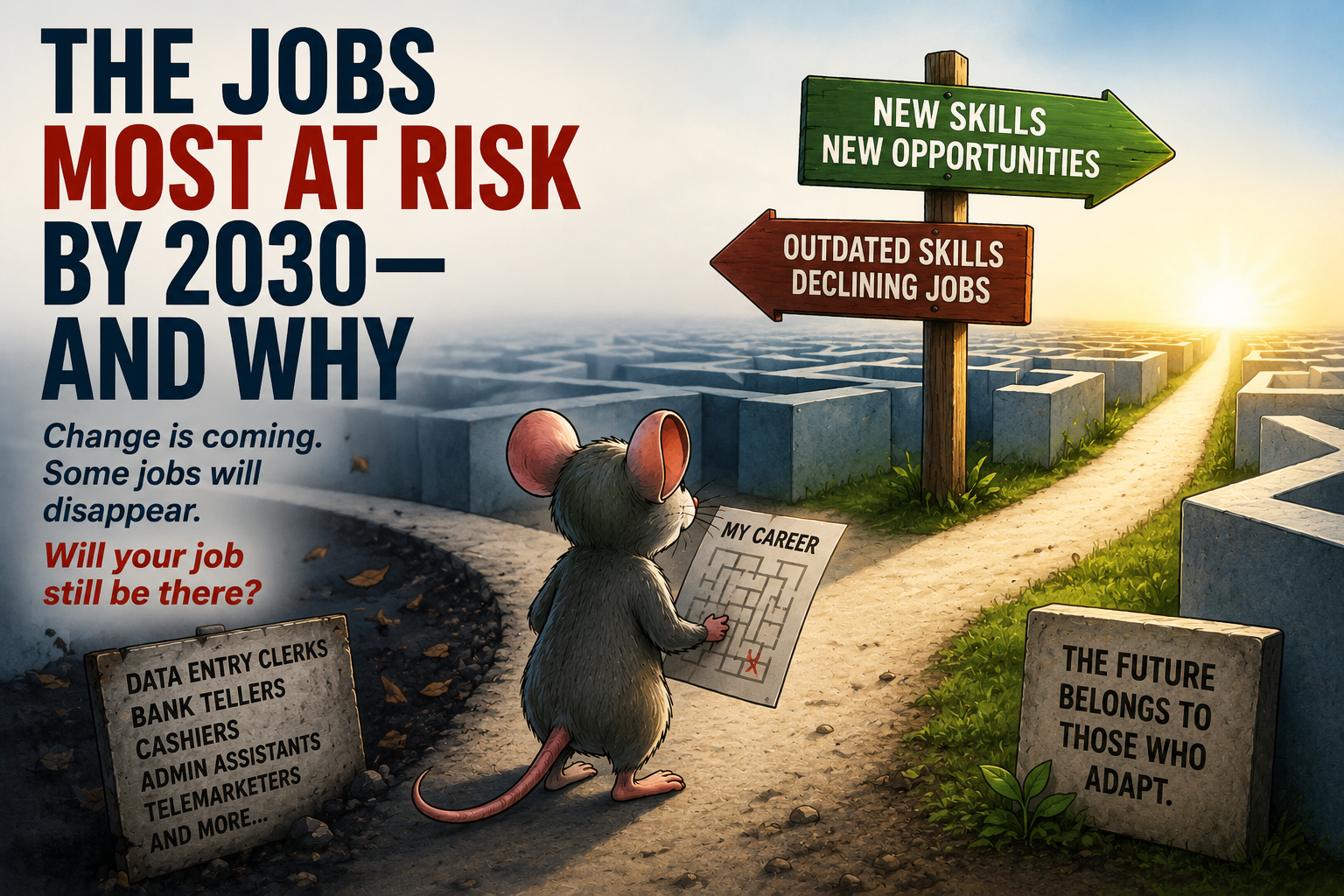

Discover which jobs the World Economic Forum says are most at risk by 2030, why they are changing, and the skills you need to stay competitive.
Many people fear that artificial intelligence will replace workers overnight.
But according to the World Economic Forum’s Future of Jobs Report 2025, the reality is more nuanced. The report doesn’t predict the end of work—it predicts the transformation of work.
While millions of new jobs are expected to emerge by 2030, many existing roles will change significantly as automation, artificial intelligence, demographic shifts, and new technologies reshape the global labour market.
For professionals planning their careers, understanding which jobs are changing—and why—has never been more important.
If you’re thinking about future-proofing your career, don’t miss our Career Resources, Future of Work, and Skills Development sections on FlexJobSpace, where we regularly publish practical advice for navigating a changing job market.
A Global Workforce Is Being Reshaped
The World Economic Forum surveyed more than 1,000 employers representing over 14 million workers across 55 economies.
The findings point to one clear conclusion:
The future of work has already begun.
By 2030:
- Around 170 million new jobs are expected to be created.
- Approximately 92 million jobs may disappear.
- Around 22% of today’s jobs will experience significant change.
- Nearly 39% of workers’ current skills are expected to become outdated or require major updating.
These figures show that the biggest challenge is not simply job loss—it’s adapting to new ways of working.
The Jobs Expected to Decline
The report identifies several occupations that are likely to see declining demand over the next five years.
These include:
- Data Entry Clerks
- Administrative Assistants
- Executive Secretaries
- Bank Tellers
- Postal Service Clerks
- Accounting, Bookkeeping and Payroll Clerks
- Cashiers
- Ticket Clerks
- Telemarketers
- Printing Workers
- Stock and Inventory Clerks
Although these roles appear different, they have one thing in common: many of their day-to-day tasks follow predictable, repetitive processes that technology can increasingly perform efficiently.
Why Are These Jobs Changing?
The decline is not necessarily because businesses are eliminating people.
Instead, technology is changing how work gets done.
Today people can:
- Transfer money through banking apps.
- Shop online.
- Check themselves out at supermarkets.
- Book travel online.
- Store documents digitally.
- Use AI tools to organise information.
As businesses automate routine administrative work, they increasingly need employees who can analyse information, solve problems, communicate effectively, and make complex decisions.
The demand is shifting from repetitive tasks toward human judgement.
Does This Mean These Careers Will Disappear?
Not necessarily.
Many occupations will evolve rather than vanish completely.
For example:
- Bank tellers increasingly become financial advisors.
- Administrative assistants often move into project coordination roles.
- Bookkeepers expand into financial analysis.
- Customer service workers develop digital support skills.
In many cases, the job title remains—but the skills required change significantly.
Workers who adapt often remain highly employable.
The Skills Employers Want Most
The same World Economic Forum report highlights the capabilities employers expect to become increasingly valuable by 2030.
Among the fastest-growing skills are:
- Analytical thinking
- Problem-solving
- AI literacy
- Technology skills
- Cybersecurity awareness
- Leadership
- Communication
- Creativity
- Curiosity
- Resilience
- Adaptability
- Lifelong learning
These skills are difficult to automate because they depend on judgement, collaboration, creativity, and emotional intelligence.
The Biggest Career Lesson
Perhaps the most important message from the report is this:
Technology is not replacing everyone.
Technology is changing the type of work people do.
The professionals most likely to succeed over the next decade are those who continue learning, embrace new technologies, and regularly update their skills.
Career growth increasingly depends on adaptability rather than simply years of experience.
What Can You Do Today?
If your role involves repetitive tasks, now is an excellent time to begin preparing for the future.
Ask yourself:
- Which parts of my job could be automated?
- Which skills make me uniquely valuable?
- What digital skills should I learn next?
- How can I become better at solving problems rather than completing routine tasks?
Small investments in learning today can make a significant difference over the next five years.
If you’re unsure where to begin, explore our Skills Development, Career Resources, and Future of Work sections for practical guides, career advice, and learning opportunities.
Final Thoughts
The future of work should not be viewed as a reason for fear, but as a reason to prepare.
The World Economic Forum’s research suggests that while some jobs will decline, many more opportunities will emerge for workers who are willing to learn and adapt.
Rather than asking whether AI will replace your job, a better question may be:
What new skills will make me valuable in 2030?
Professionals who continuously learn, embrace technology, and strengthen their human skills will be best positioned to thrive in tomorrow’s workforce.
Source
This article is based on insights from the World Economic Forum Future of Jobs Report 2025.
Official Report:
https://www.weforum.org/publications/the-future-of-jobs-report-2025
Disclaimer
FlexJobSpace is an independent career information platform. This article is an editorial summary based on publicly available research published by the World Economic Forum. Readers are encouraged to consult the original report for complete findings and methodology.