
Free FAO Forestry E-Learning Courses 2026
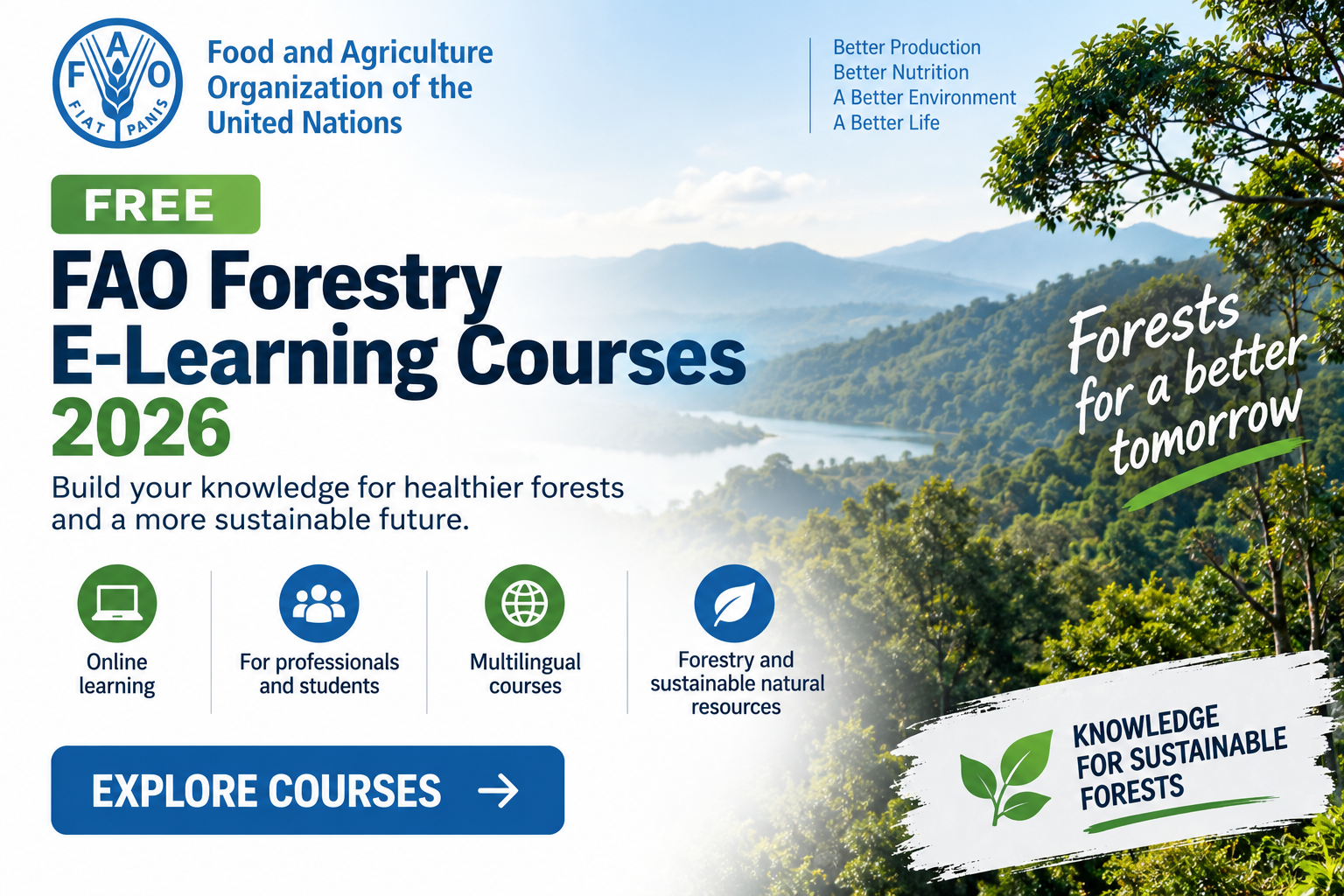
The Food and Agriculture Organization of the United Nations (FAO) is offering a range of free multilingual e-learning courses through the FAO eLearning Academy, including courses focused on forestry, sustainable forest management, climate change, biodiversity and natural resource management.
The courses are designed for professionals and students working in, or interested in, forestry and the sustainable management of natural resources. The overall goal is to strengthen the capacity of FAO member countries to contribute to the 2030 Agenda for Sustainable Development.
Free FAO Forestry Courses – Key Details
| Detail | Information |
|---|---|
| Organization | Food and Agriculture Organization of the United Nations (FAO) |
| Platform | FAO eLearning Academy |
| Subject Area | Forestry and Natural Resource Management |
| Cost | Free |
| Languages | Multilingual |
| Target Audience | Professionals and students |
| Learning Format | Online |
| Certificate | Available for selected courses where indicated |
What Can You Learn?
The FAO Forestry e-learning collection covers a wide range of topics relevant to forests, climate, agriculture, biodiversity and sustainable development.
Recent courses include Agrifood Systems Solutions for Halting Deforestation, which provides guidance and tools for identifying systemic solutions to context-specific indirect drivers of deforestation and forest degradation.
Another course focuses on Basic Integrated Fire Management Tools for Early Warning and Decision-Making, introducing an integrated approach to managing fire across landscapes while considering ecological and socio-cultural realities.
Featured FAO Forestry E-Learning Courses
Agrifood Systems Solutions for Halting Deforestation
This course explores systemic approaches to addressing deforestation and forest degradation. It provides guidance and tools for identifying solutions to indirect drivers of deforestation.
Published: 18 June 2026
Basic Integrated Fire Management Tools
This course introduces Integrated Fire Management (IFM) and its application to landscape-level fire management, including early warning and decision-making.
Published: 22 April 2026
Open Foris Arena
The Open Foris Arena series consists of short e-learning video modules designed to help learners build practical skills in areas such as survey design and the collection of high-quality field data.
Published: 22 April 2026
Uncertainty in Estimating Forest Emissions: Introduction to Monte Carlo
This course introduces Monte Carlo approaches to understanding uncertainty when estimating forest emissions. It is particularly relevant to the measurement and assessment of forest-related greenhouse gas emissions.
Published: 22 April 2026
Agroforestry for Sustainable Agrifood Transformation – Introduction
This course forms part of FAO’s efforts to strengthen the connection between agriculture and forestry and promote sustainable agrifood systems.
Published: 18 March 2026
Global Forest Resources Assessment 2025
Learners can also take a course focused on the Global Forest Resources Assessment 2025, described by FAO as an authoritative source of information on the world’s forest resources.
The course provides an opportunity to build knowledge around global forest resource assessment.
Published: 18 March 2026
Additional Forestry Courses
The FAO e-learning collection also includes courses and learning journeys covering areas such as:
- Public expenditure analysis for forests
- Forest management planning
- National forest inventories
- Forest and landscape restoration
- Biodiversity and human well-being
- Environmental integrity
- Seed and seedling supply for restoration
These courses provide opportunities for learners to develop knowledge across different aspects of forestry and sustainable natural resource management.
Who Can Take the Courses?
The FAO Forestry e-learning collection is aimed at professionals and students working in, or interested in, forestry and sustainable natural resource management.
Because the courses cover different technical areas, learners can select subjects that correspond with their professional responsibilities, academic interests or development goals.
Why Consider FAO’s Free Courses?
Online learning can provide a flexible way for professionals and students to strengthen their knowledge without needing to attend a physical training programme.
The FAO Forestry collection is particularly useful for people interested in:
- Forestry
- Sustainable forest management
- Climate change
- Deforestation
- Forest restoration
- Biodiversity
- Agroforestry
- Environmental monitoring
- Natural resource management
- Sustainable development
The availability of courses in multiple languages can also make the learning resources accessible to a wider international audience.
How to Access the Courses
Interested learners can explore the FAO Forestry e-learning collection and select a course based on their interests.
Each course page provides information about the specific learning opportunity and allows learners to access the relevant e-learning content.
Start learning through the FAO eLearning Academy and explore the Forestry collection today.
ACCESS THE FREE COURSES
Final Thoughts
The Free FAO Forestry E-Learning Courses 2026 provide an opportunity for students and professionals to strengthen their knowledge of forestry, climate change, deforestation, agroforestry, fire management, forest assessment and sustainable natural resource management.
With courses covering both technical and policy-related topics, the collection offers a useful learning resource for anyone interested in forests and their role in sustainable development.
Explore the free FAO Forestry courses and start learning online.