
GEF SGP CSO Challenge Program 2026: Apply for Up to $300,000
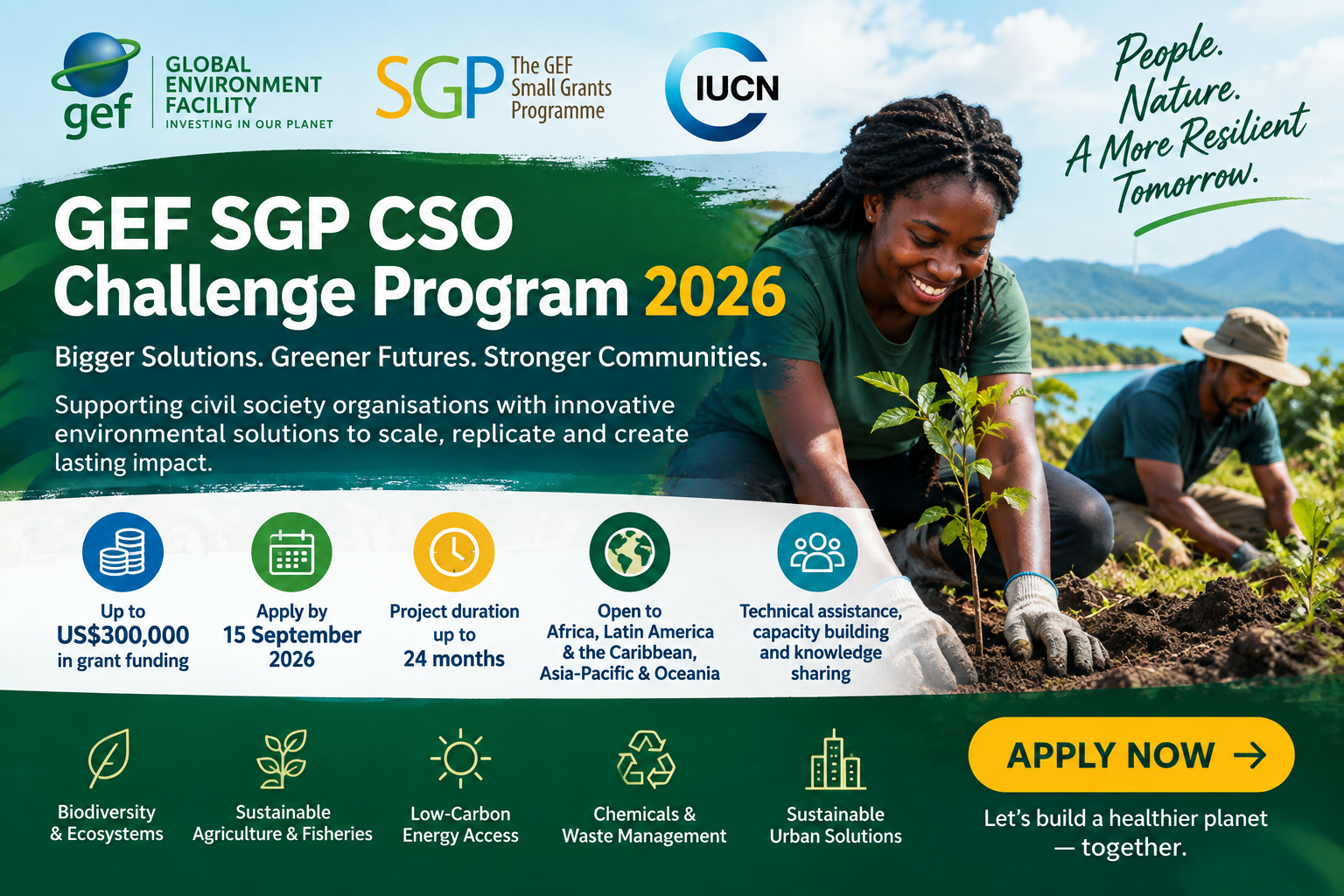
The GEF SGP CSO Challenge Program 2026 is now accepting applications from civil society organizations (CSOs) working on innovative environmental solutions in Africa, Latin America and the Caribbean, and Asia-Pacific & Oceania. Selected organizations can receive up to US$300,000 in direct grant funding, together with technical assistance, capacity building and opportunities to share and scale their work.
For organizations developing practical solutions to environmental and sustainability challenges, this is a major funding opportunity to expand an existing initiative and increase its impact.
Applications for the current regions must be submitted by 15 September 2026 at 23:59 UTC.
GEF SGP CSO Challenge Program 2026 at a Glance
| Opportunity | Details |
|---|---|
| Programme | GEF SGP CSO Challenge Program |
| Organisations eligible | Civil society organisations |
| Funding | Up to US$300,000 |
| Project duration | Up to 24 months |
| Current regions | Africa; Latin America & the Caribbean; Asia-Pacific & Oceania |
| Deadline | 15 September 2026 |
| Languages | English, French and Spanish |
| Application stage | Concept Note |
| Application method | Online grants portal |
The programme is supported by the Global Environment Facility (GEF) and the International Union for Conservation of Nature (IUCN). It was launched to identify, reward and support high-impact environmental approaches led by civil society organizations.
What Is the GEF SGP CSO Challenge Program?
The GEF SGP CSO Challenge Program is a new global funding initiative designed to help civil society organizations scale and replicate promising environmental solutions.
Unlike a conventional grant programme that may fund an idea at an early conceptual stage, the CSO Challenge Program is particularly interested in existing work with demonstrated potential for impact and scalability.
The programme recognizes that CSOs and local communities are often at the forefront of responding to climate change, biodiversity loss, land degradation and other environmental challenges. It therefore aims to provide larger grants and additional support to organizations that can demonstrate practical results and potential for wider application.
Selected organizations can receive up to US$300,000, compared with the US$75,000 limit associated with the core GEF Small Grants Programme.
GEF SGP CSO Challenge Program Focus Areas
Applicants should demonstrate how their existing work contributes to at least one of the programme’s five strategic areas:
1. Community-Based Management of Threatened Ecosystems and Species
This area supports community-led approaches that protect ecosystems, biodiversity and threatened species.
Projects may involve conservation, restoration, community stewardship or other approaches that demonstrate potential for replication and wider environmental benefits.
2. Sustainable Agriculture and Fisheries
The programme supports innovative approaches related to sustainable agriculture, fisheries and food security.
Projects should demonstrate how environmental sustainability can be combined with improved livelihoods, food security or resilient production systems.
3. Low-Carbon Energy Access
Organizations working to expand access to sustainable, low-carbon energy solutions may also be eligible.
This could include innovative approaches that help communities transition toward cleaner energy while addressing local development needs.
4. Chemicals and Waste Management
The programme also supports solutions addressing chemicals, pollution and waste.
CSOs working on innovative waste-management systems, pollution reduction, circular approaches or safer management of chemicals may therefore find this funding opportunity relevant.
5. Sustainable Urban Solutions
The fifth strategic area focuses on sustainable solutions for urban environments.
This provides an opportunity for organizations working on environmental challenges in cities and rapidly urbanizing communities to demonstrate how innovative approaches can be scaled.
Who Should Apply?
The programme is aimed at civil society organizations based in developing countries or economies in transition.
The official programme particularly welcomes proposals that involve or are led by under-represented groups, including youth, women, Indigenous Peoples and local communities.
However, meeting the basic eligibility requirements is not enough. Applicants should be able to demonstrate that the proposed initiative is based on existing work, rather than being only a new concept.
A strong application should therefore clearly communicate:
- What problem the organization is addressing
- What solution has already been developed or tested
- Evidence of results or impact
- Why the approach is innovative
- How the solution can be scaled or replicated
- Who benefits from the intervention
- How the project contributes to environmental benefits
- Why additional funding is necessary at this stage
How Much Funding Is Available?
Selected CSOs can receive up to US$300,000 in direct grant funding.
Projects can run for up to 24 months, allowing successful organizations to use the funding to scale or replicate promising environmental solutions.
Importantly, financial support is not the only benefit.
Selected organizations can also receive tailored technical assistance covering areas such as results tracking, environmental and social risk management, programme design and engagement with private-sector partners.
The programme also provides opportunities for capacity building, collaboration, knowledge sharing and increased visibility for participating CSOs.
GEF SGP CSO Challenge Program Application Process
The application process consists of two main stages.
Stage 1: Submit a Concept Note
Applicants initially submit a Concept Note through the online grants portal.
The Concept Note provides the programme with an opportunity to assess the proposed solution, its environmental impact, the organization’s experience and the potential for scaling or replication.
Applicants should use the latest official Concept Note template when preparing their submission.
Stage 2: Full Proposal
Organizations whose Concept Notes are shortlisted will be invited to submit a Full Proposal.
For the Africa, Latin America & the Caribbean, and Asia-Pacific & Oceania regions, finalists are expected to be notified in October 2026, with Full Proposal submissions due in November 2026. Final selection is expected in December 2026.
Application Deadline
The deadline depends on the geographical region.
For Africa, Latin America & the Caribbean, and Asia-Pacific & Oceania, the current application deadline is:
15 September 2026 at 23:59 UTC
The Eastern Europe, Caucasus & Central Asia application round closed on 7 August 2026.
Organizations applying from Africa should therefore prioritize completing their Concept Note well before the deadline.
How to Apply for the GEF SGP CSO Challenge Program
Applications must be submitted through the programme’s online grants portal.
Applicants should first review the official eligibility requirements, Call for Proposals and Guidelines for Applicants before beginning their submission.
The programme accepts proposals in:
- English
- Français
- Español
Applicants will need to create an account or sign in to the application portal before submitting their Concept Note.
Official application resources:
APPLY ON THE OFFICIAL WEBSITE
Apply through the official grants portal
Guidelines for Applicants – English
What Makes a Strong Application?
Organizations should avoid treating the GEF SGP CSO Challenge Program as an ordinary project-funding application.
The programme is specifically looking for high-impact and innovative environmental solutions with potential for scaling or replication.
A competitive Concept Note should therefore tell a clear story:
Problem → Existing Solution → Evidence → Innovation → Environmental Impact → Scale
Applicants should be particularly clear about what has already been achieved.
For example, instead of simply stating that an organization intends to develop a community conservation model, the application should explain what the organization has already tested, what results have been achieved, what has been learned and why additional funding can help take the solution to a larger scale.
Important Note About the Concept Note
Applicants should make sure they are using the latest version of the Concept Note template before preparing their submission.
The official programme information indicates that the current template was updated on 28 July 2026. Applicants should download the form and complete it using Adobe Acrobat Reader on a computer rather than relying on a browser or mobile device.
This is particularly important because submitting an outdated template or an incomplete application could create avoidable problems during the review process.
Why This Opportunity Matters for African CSOs
For African civil society organizations, the GEF SGP CSO Challenge Program offers an opportunity to move successful environmental initiatives beyond the pilot stage.
The availability of grants of up to US$300,000 can provide organizations with the resources needed to expand programmes, strengthen evidence, reach additional communities and replicate successful approaches in new locations.
The programme’s additional technical and capacity-building support is also important because scaling an intervention requires more than financial resources. Organizations may need stronger monitoring systems, environmental and social safeguards, partnership strategies and approaches for communicating results.
Final Thoughts
The GEF SGP CSO Challenge Program 2026 is particularly relevant for organizations that already have an innovative environmental solution and can demonstrate its potential to create wider impact.
With grants of up to US$300,000, projects lasting up to 24 months and additional technical and capacity-building support, the programme offers more than conventional project financing. It is designed to help promising CSO-led solutions scale, replicate and gain wider recognition.
For applicants in Africa, Latin America & the Caribbean, and Asia-Pacific & Oceania, the key date to remember is 15 September 2026.
If your organization has an established environmental solution with evidence of impact and a credible pathway to scale, this is an opportunity worth exploring before the deadline.