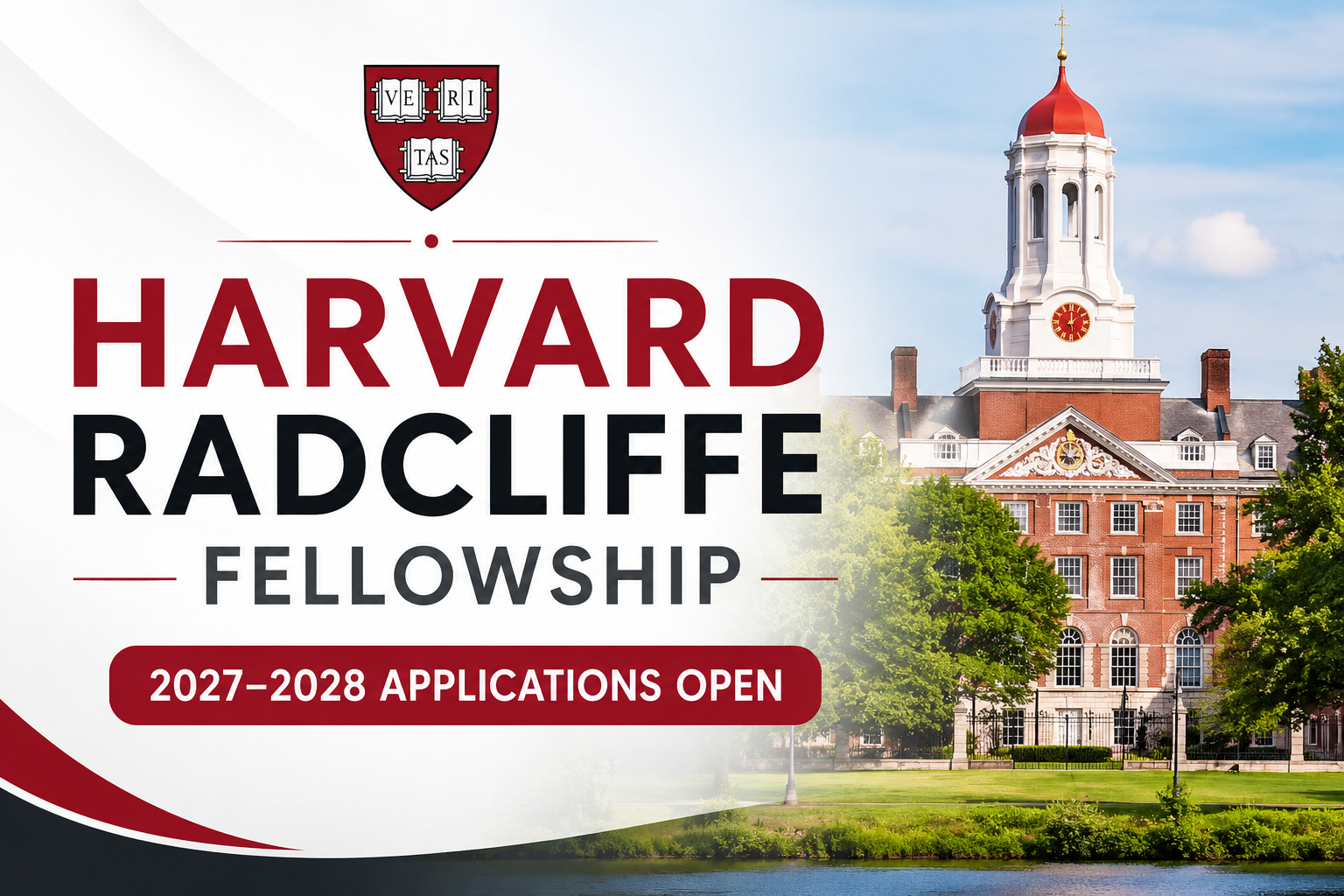

Applications are open for the Harvard Radcliffe Fellowship 2027–2028. Scholars, scientists, writers, journalists, and artists are invited to apply.
For many academics, writers, researchers, journalists, and artists, one challenge remains constant: finding uninterrupted time to focus on ambitious work.
Teaching responsibilities, administrative duties, funding pressures, and daily commitments often leave little room for deep thinking and creative exploration.
The Harvard Radcliffe Fellowship Program seeks to solve that problem.
Applications are now open for the Harvard Radcliffe Fellowship 2027–2028, one of the world’s most prestigious interdisciplinary fellowship programmes. Each year, the programme brings together exceptional scholars, scientists, public intellectuals, journalists, and artists to spend an academic year pursuing innovative projects while benefiting from the intellectual resources of Harvard University.
For professionals looking to advance important research, produce groundbreaking creative work, or tackle complex policy challenges, this fellowship represents a rare opportunity to step back from routine demands and focus fully on transformative ideas.
Table of Contents
About the Harvard Radcliffe Institute
The Harvard Radcliffe Institute is one of Harvard University’s leading centers for advanced study and interdisciplinary collaboration.
The Institute brings together experts from diverse disciplines to address some of society’s most pressing challenges through research, scholarship, artistic practice, and public engagement.
Unlike traditional academic departments that focus on specific disciplines, Radcliffe encourages collaboration across fields, creating opportunities for unexpected partnerships and innovative thinking.
Its fellows have included Pulitzer Prize winners, MacArthur Fellows, leading scientists, policymakers, historians, novelists, journalists, artists, and public intellectuals.
Why This Fellowship Stands Out
Many fellowship programmes provide funding.
The Harvard Radcliffe Fellowship offers something equally valuable: time, intellectual freedom, and access to one of the world’s most influential academic communities.
Selected fellows spend a full academic year pursuing independent projects while engaging with colleagues from different disciplines.
This interdisciplinary environment often sparks new ideas, collaborations, and perspectives that would not emerge within traditional academic settings.
For many fellows, the programme becomes a turning point in their careers.
Who Can Apply?
The fellowship welcomes applicants from a wide range of disciplines and professional backgrounds.
Eligible applicants may include:
Scholars
Researchers working in:
- Humanities
- Social sciences
- History
- Political science
- Law
- Education
- Public policy
- International development
Scientists
Researchers in:
- Science
- Technology
- Engineering
- Mathematics
- Environmental sciences
- Health-related fields
Writers and Journalists
Including:
- Nonfiction writers
- Journalists
- Essayists
- Public intellectuals
- Authors
Artists
Creative practitioners across a range of artistic disciplines.
The programme accepts applications from individuals at different career stages and does not require applicants to hold tenure.
However, current degree-seeking students are not eligible.
What Kind of Projects Are Competitive?
The Institute welcomes ambitious projects that address important questions facing society.
Particular interest areas include:
Social and Policy Challenges
Projects exploring major social, economic, political, and cultural issues.
Academic Freedom and Public Dialogue
The Institute’s current multiyear focus includes:
- Academic freedom
- Diversity of thought
- Intellectual inquiry
- Political polarization
- Religious pluralism
- Higher education policy
Gender and Society
Reflecting Radcliffe’s history, projects examining women, gender, and society remain an important area of interest.
Science and Research Innovation
The programme also welcomes proposals in science, engineering, and mathematics, particularly areas affected by recent research funding challenges.
The Growing Importance of Interdisciplinary Research
Many of today’s most significant problems cannot be solved through a single discipline.
Climate change involves science, economics, law, and public policy.
Artificial intelligence raises questions about technology, ethics, governance, and social impact.
Public health challenges require collaboration across medicine, sociology, economics, and political science.
The Radcliffe Fellowship recognizes this reality by encouraging researchers and practitioners to engage across disciplinary boundaries.
This approach helps generate new insights and innovative solutions.
What Fellows Gain Beyond Funding
The fellowship provides far more than financial support.
Participants gain:
Time for Deep Work
Perhaps the most valuable resource available to modern professionals.
Access to Harvard Resources
Including libraries, research centers, faculty expertise, and academic events.
Interdisciplinary Collaboration
Opportunities to interact with experts from completely different fields.
Professional Visibility
Association with one of the world’s leading academic institutions can strengthen future career opportunities.
Long-Term Networks
Many fellows continue collaborating long after their fellowship year ends.
Why This Fellowship Matters in Today’s World
The pace of global change continues to accelerate.
Researchers and practitioners increasingly face pressure to produce quick results.
Yet many of the most important breakthroughs require sustained reflection, experimentation, and intellectual risk-taking.
Programmes like the Harvard Radcliffe Fellowship create space for exactly this type of work.
By supporting ambitious projects and encouraging interdisciplinary dialogue, the programme contributes to knowledge creation that can influence scholarship, public policy, science, culture, and society for years to come.
Application Tips
Competition for the fellowship is extremely strong.
Successful applicants often demonstrate:
A Clear Research or Creative Vision
Reviewers want to understand exactly what you plan to accomplish.
Originality
Strong proposals offer new perspectives or innovative approaches.
Broader Impact
Applicants should explain why their work matters beyond their immediate field.
Feasibility
Even ambitious projects must demonstrate realistic goals and methods.
Effective Communication
Proposal reviewers may come from different disciplines, so clarity is essential.
Avoid excessive jargon and explain complex concepts in accessible language.
Important Deadlines
Humanities, Social Sciences, Creative Arts, Nonfiction and Journalism
Application Deadline:
10 September 2026 (5:00 PM ET)
Science, Engineering and Mathematics
Application Deadline:
1 October 2026 (5:00 PM ET)
Applicants are encouraged to begin preparing materials early, as strong proposals often require significant planning and revision.
How to Apply
Applications are submitted through the official Harvard Radcliffe Fellowship application portal.
Applicants will generally need:
- Application form
- Curriculum Vitae (CV)
- Project proposal
- Writing sample or work sample
- Three references
Candidates should carefully review discipline-specific requirements before submitting an application.
Final Thoughts
The Harvard Radcliffe Fellowship 2027–2028 is more than a prestigious academic opportunity.
It offers scholars, scientists, writers, journalists, and artists something increasingly rare: the time, resources, and intellectual community needed to pursue work that could shape conversations for years to come.
For individuals with ambitious projects and a desire to engage with one of the world’s most dynamic interdisciplinary environments, this fellowship deserves serious consideration.
Disclaimer
FlexJobSpace is an independent opportunity-sharing platform and is not affiliated with Harvard University or the Harvard Radcliffe Institute. Applicants should verify all eligibility requirements, deadlines, and application procedures through the official fellowship website before applying.