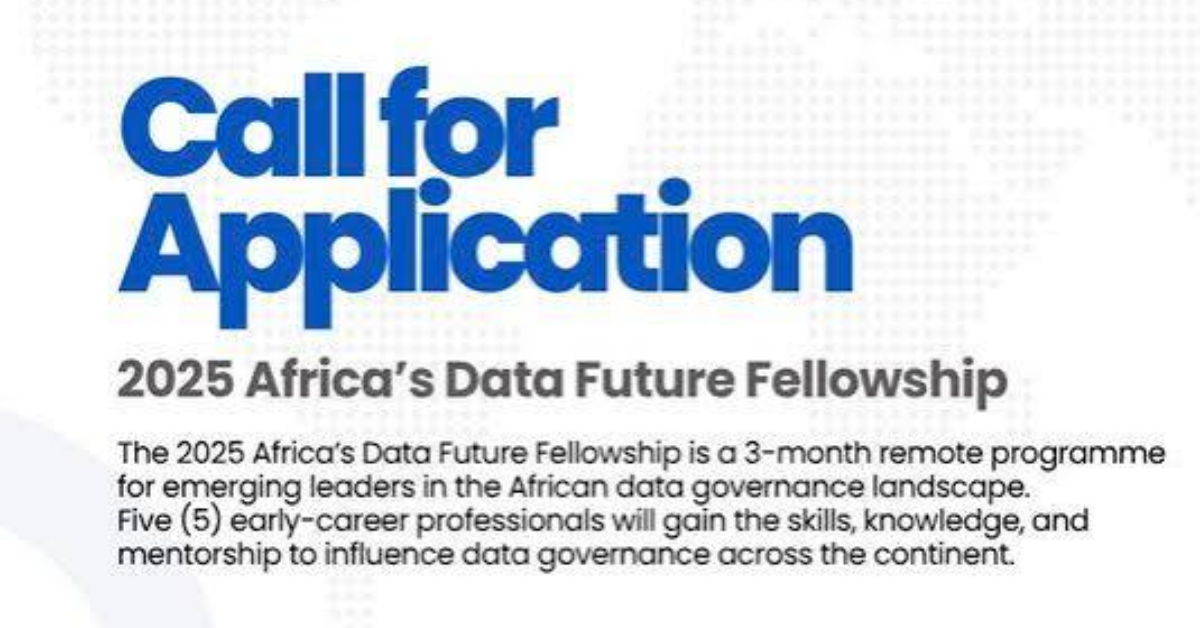

Applications are open for the 2026 Africa’s Data Future Fellowship, a three-month remote programme for emerging African data governance and digital policy professionals. Ten fellows will be selected, with up to $1,500 available upon successful completion. Deadline: September 18, 2026.
The 2026 Africa’s Data Future Fellowship is accepting applications from emerging African professionals working across data governance, digital policy, artificial intelligence, technology and related fields.
Organized by the Centre for the Study of the Economies of Africa (CSEA), the fellowship is a three-month virtual capacity-building programme scheduled to begin in October 2026. It is designed to strengthen participants’ knowledge, policy research skills and professional networks while supporting emerging African voices in discussions about the continent’s digital future.
Only 10 fellows from across Africa are expected to be selected. Successful participants can receive a stipend of up to US$1,500 upon successful completion of the programme.
Applications close on September 18, 2026.
| Category | Details |
|---|---|
| Programme | 2026 Africa’s Data Future Fellowship |
| Organization | Centre for the Study of the Economies of Africa (CSEA) |
| Location | Remote – Africa |
| Format | Fully virtual |
| Duration | 3 months |
| Start date | October 2026 |
| Fellows selected | 10 |
| Stipend | Up to US$1,500 upon successful completion |
| Weekly commitment | At least 2 hours |
| Languages listed | English and French |
| Application language | English |
| Target group | Emerging African data governance and digital policy professionals |
| Deadline | September 18, 2026 |
What Is Africa’s Data Future Fellowship?
Africa’s Data Future Fellowship is a capacity-building initiative aimed at early-career professionals and changemakers interested in shaping how data, technology and digital systems develop across Africa.
The programme focuses particularly on data governance and digital transformation.
Rather than functioning only as a training course, the fellowship combines expert engagement with practical policy research.
Participants will attend virtual expert sessions, engage with professionals in the sector and develop their own policy-oriented outputs.
Each fellow is expected to produce a policy brief and blog post and eventually present their findings during a dedicated fellowship workshop.
This makes the opportunity particularly relevant to applicants who want to strengthen both their technical understanding of digital-policy issues and their ability to translate research into practical policy recommendations.
Six Fellowship Thematic Areas
The 2026 cohort will concentrate on six areas that are increasingly important to Africa’s digital transformation.
1. Digital Rights
Digital rights involve questions surrounding people’s rights and freedoms in increasingly digital societies.
Applicants interested in this area may explore challenges connected with the development and governance of digital technologies.
2. Data Sharing
Data sharing is becoming increasingly important as governments, businesses, researchers and other institutions depend on information to make decisions and provide services.
The fellowship provides space for participants interested in examining data-sharing questions within the African context.
3. Data Value Chain
The data value chain considers the broader processes through which data is collected, managed and transformed into useful information and value.
This area may be particularly relevant to professionals already working with data systems, research or digital-policy institutions.
4. Digital Public Infrastructure
Digital public infrastructure has become an important policy topic as governments increasingly use digital systems to deliver services and support economic activity.
The fellowship identifies this as one of its central areas for the 2026 cohort.
5. Regulatory Interoperability
The programme will also examine regulatory interoperability, an increasingly relevant issue as digital technologies, platforms and data move across institutional and national boundaries.
6. Data Sovereignty
Data sovereignty is the sixth thematic area and provides another route for fellows interested in the relationship between data, governance, institutions and national or regional policy.
Applicants will need to identify a relevant thematic area when preparing their fellowship application.
How the Three-Month Fellowship Works
The fellowship is scheduled to begin in October 2026 and continue for three months.
Because the programme is virtual, fellows can participate remotely from their respective African countries.
Participants are expected to take part in bi-weekly virtual expert brainstorming sessions and masterclasses involving sector leaders.
The minimum time commitment is two hours per week throughout the fellowship.
However, applicants should also account for the time required to research and develop their policy brief, write their blog post, interact with a relevant institution and prepare their final presentation.
Fellows Will Engage With an Institution in Their Country
One particularly useful component of the programme is its connection to existing data and digital-policy ecosystems.
Participants will be expected to engage with a relevant institution within their own country.
The purpose is to help disseminate findings developed through the fellowship and connect participants’ work with organizations already involved in digital policy, data governance or related fields.
This could help fellows move beyond purely theoretical learning and engage with real policy conversations within their national contexts.
What Fellows Must Produce
The fellowship has clear expected outputs.
Each selected participant must develop a detailed policy brief addressing an issue related to one of the programme’s thematic areas.
Fellows must also produce a blog post connected with their chosen topic.
Finally, participants are expected to present their findings at a dedicated fellowship workshop.
These outputs are important because the programme is intended to help participants turn professional knowledge and research interests into practical policy insights relevant to Africa’s digital transformation.
Fellowship Benefits
One of the headline benefits is financial support.
Successful fellows can receive up to US$1,500 upon successful completion of the fellowship.
Applicants should pay attention to the wording. The source describes this as a stipend available upon successful completion rather than an unconditional payment made immediately after selection.
Beyond the stipend, selected fellows can benefit from:
- Bi-weekly virtual masterclasses and expert sessions with sector leaders
- Opportunities for their work to be featured on CSEA platforms
- Access to a Pan-African professional network
- Exposure to professionals and experts working in data governance and digital transformation
- Practical experience producing policy-oriented research
- Opportunities to strengthen professional connections across Africa
Because the fellowship is virtual, the supplied information does not describe international travel or accommodation funding.
Who Can Apply?
The fellowship has fairly specific eligibility requirements.
Applicants must hold a postgraduate degree and have at least one year of professional experience.
Relevant professional or academic areas include:
- Social sciences
- Law
- Technology
- Data policy
- Related fields
Applicants must also be from an African country and currently reside in an African country.
This means the programme is specifically targeted toward professionals based on the continent.
Professional Engagement Requirement
Holding an eligible academic qualification alone is not enough.
Candidates should currently be working or professionally engaged in areas such as:
Data governance
Digital policy
Artificial intelligence
Technology
Related areas
The programme is therefore best suited to applicants who can connect their existing professional work with the fellowship’s focus.
Eligible Professional Sectors
The fellowship welcomes professionals working or professionally engaged across several sectors.
These include government institutions and private-sector organizations.
Professionals working with AI startups can also be relevant applicants. The source specifically mentions areas such as:
- Fintech
- Edtech
- Healthtech
- Agritech
- Related ventures
Applicants can additionally come from research institutions, policy think tanks, universities and civil society organizations.
This cross-sector approach could produce a cohort containing professionals with substantially different perspectives on Africa’s data ecosystem.
Additional Experience That Can Strengthen an Application
An interest in or experience related to the public sector, data governance, digital policy and/or technology is described as an added advantage.
Applicants should therefore use their statement of interest to demonstrate relevant professional exposure where applicable.
The strongest application is likely to be one that clearly connects the candidate’s existing work with a specific problem they want to investigate during the fellowship.
Technology Requirements
Since the programme is delivered remotely, applicants must have:
Reliable internet access
and
A functional computer for the duration of the fellowship.
Applicants should consider this requirement before applying because participation involves recurring virtual sessions as well as research and written assignments.
Application Requirements
The fellowship application must be submitted in English.
Candidates are expected to provide several materials.
Completed Application Form
Applicants must complete the fellowship’s online application form.
Information entered should be accurate and consistent with supporting materials.
CV — Maximum Two Pages
Applicants need to submit a CV of no more than two pages.
Given the limit, candidates should prioritize experience most relevant to data governance, digital policy, AI, technology, research and public policy.
Statement of Interest — Maximum 300 Words
Applicants must prepare a statement of interest of no more than 300 words.
The statement should explain their interest in the selected fellowship thematic area or areas.
Rather than simply saying that data governance is important, candidates can use this space to demonstrate how the fellowship connects with their professional work and future goals.
Problem Statement — Maximum 300 Words
Applicants must also submit a problem statement of no more than 300 words.
It should identify a data governance or digitalisation challenge affecting the applicant’s sub-region and connect that challenge with one of the fellowship’s thematic areas.
This is an important component because it gives selectors an indication of the applicant’s ability to identify and frame a relevant policy problem.
Writing Sample
Applicants must provide a relevant writing sample.
Examples given include a policy brief or research paper focused on:
- Data governance
- Artificial intelligence
- Digital policy
- A related subject
Candidates should select a sample that demonstrates their ability to analyze issues clearly and communicate evidence or policy ideas effectively.
How Competitive Is the Fellowship?
Only 10 fellows from across Africa are expected to be selected.
The source does not state how many applications CSEA expects to receive, so an acceptance rate cannot reliably be calculated.
However, the limited cohort means applicants should treat the selection process seriously.
A strong application should demonstrate a clear relationship between the applicant’s experience, proposed policy problem and one of the six fellowship themes.
Generic statements about being interested in technology are unlikely to communicate as much value as a clearly defined policy interest backed by relevant professional or research experience.
How to Strengthen Your Application
Applicants should first choose the thematic area that most closely aligns with their existing expertise.
The problem statement should then identify a specific challenge rather than trying to discuss every digital-policy issue facing Africa.
Candidates should also make good use of the strict 300-word limits. Clear writing, a defined problem and an explanation of why the issue matters can be more effective than overly broad descriptions.
The two-page CV should similarly prioritize relevant achievements instead of attempting to document every activity the applicant has undertaken.
Finally, candidates should select a writing sample that shows their ability to work with policy or research questions relevant to the fellowship.
Application Mistakes to Avoid
One potential mistake is overlooking the residency requirement. Applicants must be from and currently residing in an African country according to the supplied eligibility information.
Another is submitting documents that exceed the stated limits. The CV is limited to two pages, while both the statement of interest and problem statement have maximum lengths of 300 words.
Applicants should also avoid submitting a problem statement that has little connection with the six fellowship themes.
Because a relevant writing sample is requested, candidates should choose material that demonstrates genuine analytical or policy-writing ability.
Finally, applicants should not wait until the final hours before submitting. Technical issues, internet problems or incomplete documents can create avoidable difficulties.
Application Deadline
The deadline for the 2026 Africa’s Data Future Fellowship is September 18, 2026.
The programme is scheduled to begin in October 2026, leaving a relatively short period between application closing and programme commencement.
Candidates should therefore prepare their CV, statement of interest, problem statement and writing sample as early as possible.
How to Apply for Africa’s Data Future Fellowship 2026
Applications are submitted online through the fellowship information provided by CSEA.
Apply for the 2026 Africa’s Data Future Fellowship
Applicants should review the programme information carefully before submitting their materials.
Frequently Asked Questions
Is Africa’s Data Future Fellowship 2026 remote?
Yes. The fellowship is described as a virtual programme for participants based across Africa.
How long does the fellowship last?
The programme runs for three months, beginning in October 2026.
How many fellows will be selected?
The programme is expected to select 10 fellows from across Africa.
How much is the fellowship stipend?
Successful fellows can receive up to US$1,500 upon successful completion of the programme.
Is the $1,500 paid immediately after selection?
The supplied information states that the stipend is available upon successful completion. It does not describe it as an upfront payment.
Do applicants need a postgraduate degree?
Yes. The stated eligibility criteria require applicants to hold a postgraduate degree.
Is professional experience required?
Yes. Applicants need at least one year of professional experience in a relevant field.
Can applicants living outside Africa apply?
The supplied criteria state that candidates must be from and currently reside in an African country.
How much time must fellows commit?
Participants should be able to commit at least two hours per week throughout the programme.
What are the six fellowship themes?
They are Digital Rights, Data Sharing, Data Value Chain, Digital Public Infrastructure, Regulatory Interoperability and Data Sovereignty.
What documents are required?
The listed application materials include a completed application form, a CV of no more than two pages, a statement of interest of no more than 300 words, a problem statement of no more than 300 words and a relevant writing sample.
When is the deadline?
Applications close on September 18, 2026.
Why This Fellowship Matters
Africa’s expanding digital economy creates important questions about how data should be governed, shared and used while digital systems increasingly influence governments, businesses and communities.
The Africa’s Data Future Fellowship 2026 provides a focused opportunity for emerging professionals already working within this environment to deepen their knowledge and translate their experience into policy-oriented research.
Its combination of expert masterclasses, policy writing, institutional engagement and Pan-African networking makes it more than a conventional online training programme.
With only 10 fellows, a three-month remote format and a stipend of up to US$1,500 upon successful completion, eligible professionals interested in Africa’s data governance and digital transformation landscape should consider preparing their applications ahead of the September 18, 2026 deadline.
SEO Keywords
Africa’s Data Future Fellowship 2026, Africa Data Future Fellowship, CSEA Fellowship 2026, African fellowships 2026, remote fellowships Africa, paid fellowships Africa 2026, data governance fellowship, digital policy fellowship Africa, AI fellowship Africa, CSEA Africa fellowship, fellowships for African professionals, remote fellowship 2026, $1500 fellowship Africa, data governance Africa, digital transformation fellowship, African technology fellowship, policy research fellowship Africa, Digital Rights Africa, Data Sharing Africa, Digital Public Infrastructure Africa, Data Sovereignty Africa, AI policy fellowship, technology fellowships 2026, African researchers fellowship, fellowships for postgraduate professionals, CSEA opportunities, African digital policy opportunities, Pan-African fellowship, remote opportunities Africa 2026, September 2026 fellowship deadline
Stay Connected with FlexJobSpace
Never miss the latest graduate programmes, internships, scholarships, fellowships, government jobs, NGO careers, and international opportunities.
Career coaching services
Colleges & Universities
🌍 Website
Explore Global Grants
📱 WhatsApp Community 1
https://chat.whatsapp.com/Gh3enT0Wr8N5Un0jg9areJ?mode=gi_t
📱 WhatsApp Community 2
https://chat.whatsapp.com/IKc5D9ozOVrGPLucdarML7?mode=gi_t
📢 WhatsApp Channel