
UNDP Graduate Programme 2026 – Eligibility, Benefits, and How to Apply
The UNDP Graduate Programme offers talented young graduates an opportunity to gain hands-on international development experience while working with the United Nations Development Programme (UNDP). The programme is designed to help young professionals develop the skills, experience and networks needed to build careers in international development and contribute to the achievement of the Sustainable Development Goals (SDGs).
The programme was launched in 2021 to strengthen workforce diversity, build organisational capacity and create a talent pipeline for the next generation of UNDP professionals. It complements other UNDP young talent programmes and focuses on recent graduates from UNDP programme countries.
What Is the UNDP Graduate Programme?
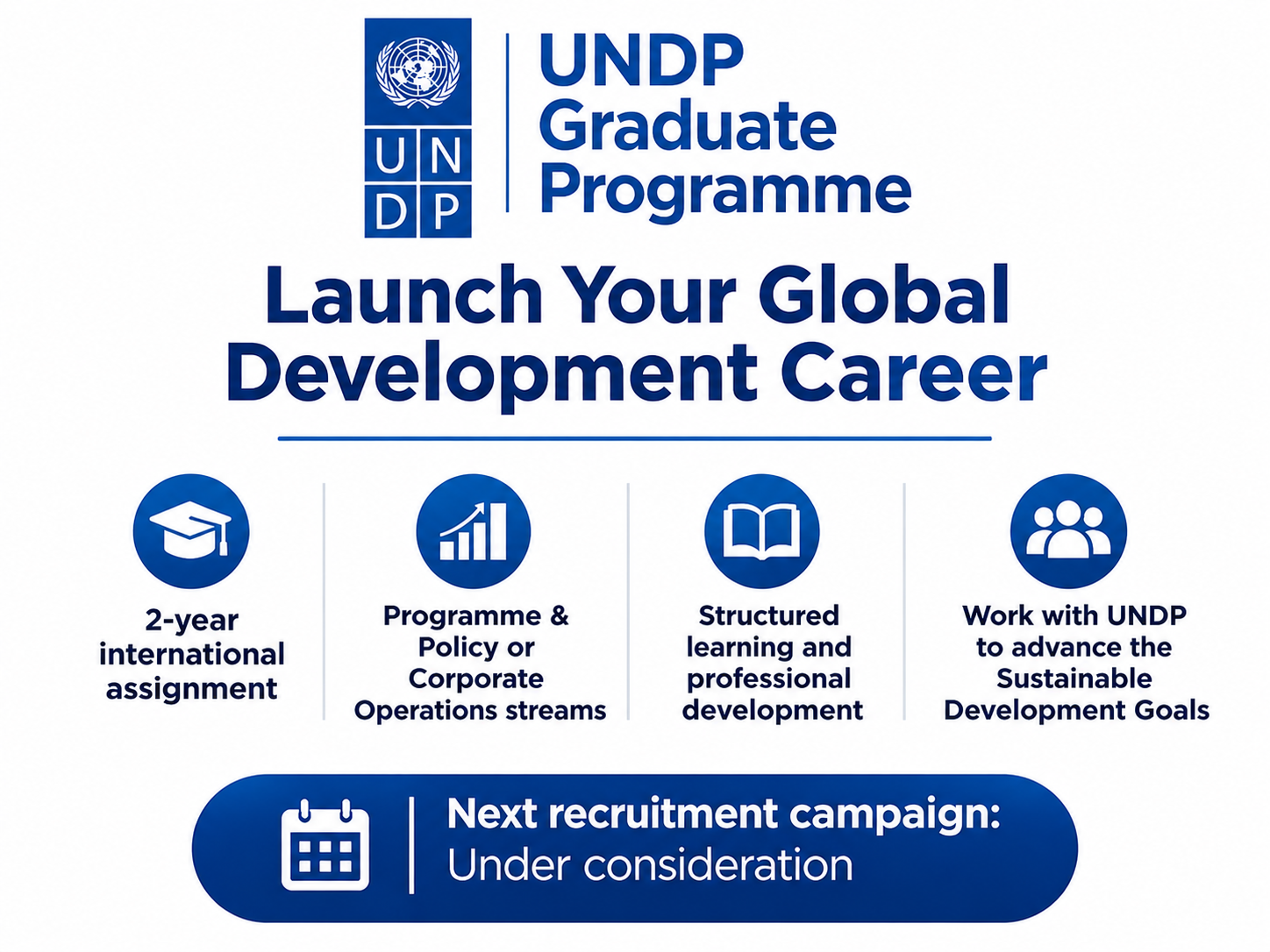
The UNDP Graduate Programme provides selected graduates with a two-year international assignment in a UNDP country, regional or headquarters office. Participants work on areas connected to sustainable development and gain practical experience in a multicultural international organisation.
The programme has two principal streams. The Programme and Policy stream allows participants to contribute to UNDP programmes and projects, while the Corporate Operations stream focuses on management services, organisational policies, processes and oversight that support the effective implementation of UNDP programmes.
The programme therefore provides more than an entry-level employment opportunity. It is designed as a pathway into international development, giving participants exposure to multilateral cooperation, sustainable development and the wider UN system.
Who Can Apply for the UNDP Graduate Programme?
The UNDP Graduate Programme is aimed at young professionals from UNDP programme countries who are interested in pursuing careers in international development.
Applicants must meet specific education and experience requirements.
Candidates with a Master’s degree or equivalent qualification in a relevant field may apply with a maximum of one year of relevant work experience.
Candidates holding a Bachelor’s degree in a relevant field must have between two and three years of relevant professional experience.
Applicants should also demonstrate a strong interest in international development and a commitment to accelerating progress towards the Sustainable Development Goals.
UNDP particularly values candidates with strong systems-thinking, innovation and digital skills. Fluency in English, both written and spoken, is required, while working knowledge of French, Arabic or Spanish may be an advantage or a requirement for some assignments.
Candidates must also be prepared to live and work for two years in another country as part of the international assignment.
Who Does UNDP Encourage to Apply?
The programme places emphasis on diversity and inclusion. Women, individuals from minority groups, indigenous peoples and persons with disabilities are encouraged to apply.
UNDP also strongly encourages graduates who are the first generation in their families to attend university to consider the programme.
This focus reflects the Graduate Programme’s objective of bringing new and diverse perspectives into the organisation while developing the next generation of development professionals.
What Does the UNDP Graduate Programme Offer?
One of the programme’s major benefits is the opportunity to gain international professional experience. Participants can be assigned to UNDP country offices, regional offices or headquarters and work directly on development-related initiatives.
The programme also provides a customised Formation Journey designed to support participants’ professional and personal development. Through this learning pathway, graduates can strengthen their knowledge, develop new capabilities and gain real-world experience alongside professionals working in international development.
For graduates seeking careers in the United Nations, development agencies, public policy, international relations, sustainability or development cooperation, the programme can provide valuable exposure to the international development sector.
Previous UNDP Graduate Programme Cohorts
The programme has already attracted significant interest from graduates around the world.
The first cohort, launched in 2021, received more than 38,000 applications from over 130 UNDP programme countries. Thirty-three candidates were selected for the talent pool, with 18 subsequently deployed in 2022.
The second cohort in 2022 attracted more than 37,000 applications from 145 UNDP programme countries. Thirty-six candidates were selected for the talent pool, with 19 deployed during 2023–2024.
Previous graduates have been deployed to duty stations across different regions, including the United States, Türkiye, Thailand, Trinidad and Tobago, Mongolia, the Philippines, Papua New Guinea, Samoa, Timor-Leste, Maldives, Laos, Jamaica, Switzerland, Bhutan, Micronesia and Solomon Islands.
When Is the Next UNDP Graduate Programme Recruitment?
Applicants interested in the programme should therefore monitor official UNDP careers information and prepare their applications in advance. Potential candidates can use this time to update their CVs, strengthen relevant professional experience, prepare examples demonstrating systems-thinking and innovation, and ensure that their academic and professional qualifications meet the programme’s requirements.
The UNDP Graduate Programme remains an attractive opportunity for young graduates seeking to enter the United Nations and international development sector, particularly those interested in sustainable development, policy, programme implementation, digital transformation and global development cooperation.