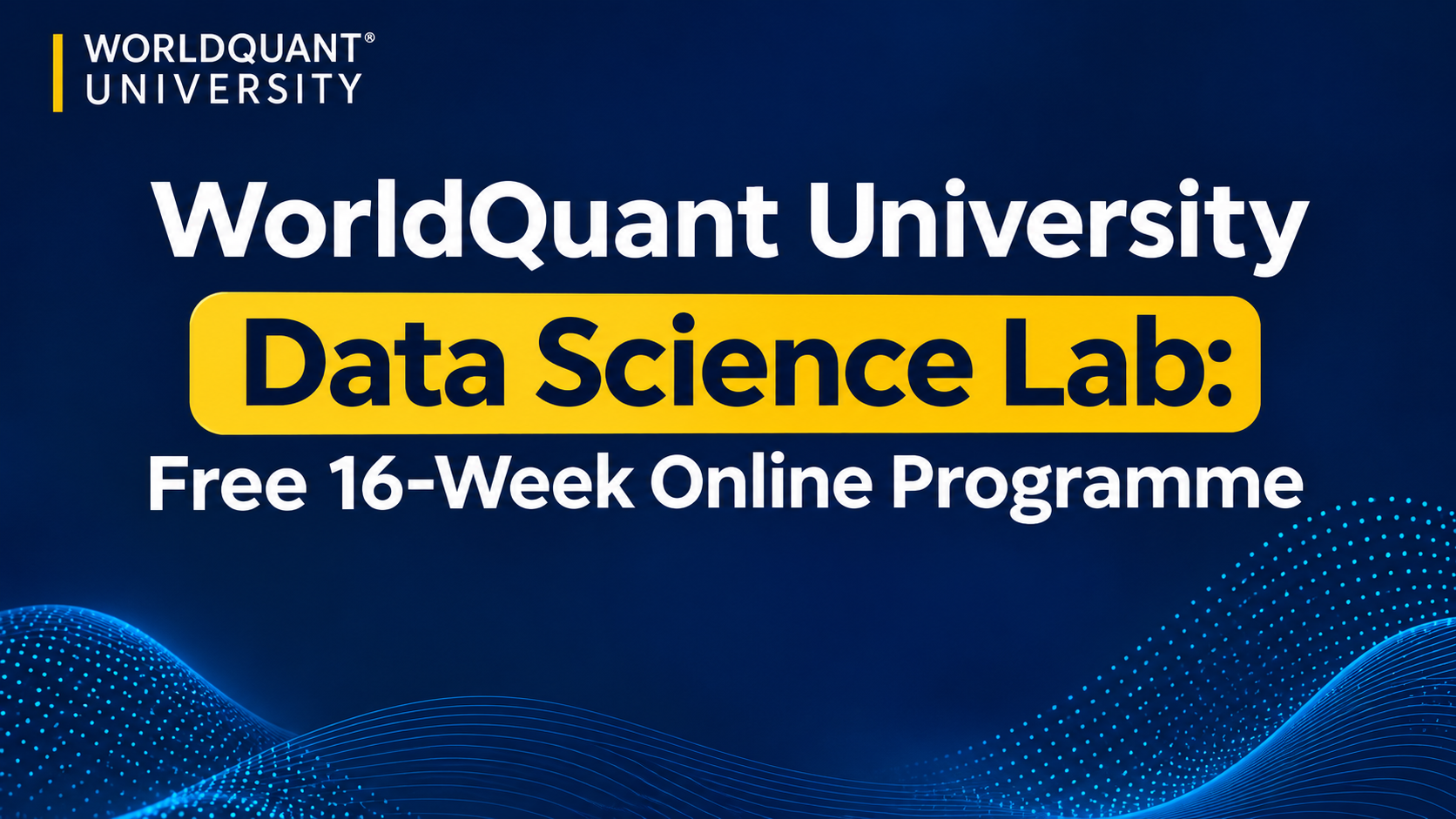

WorldQuant University Data Science Lab: Free 16-Week Online Programme
WorldQuant University (WQU) offers the Data Science Lab, a completely online and free programme designed to help aspiring data scientists and AI practitioners develop practical, job-ready skills through real-world projects.
About the Data Science Lab
The Data Science Lab focuses on applied learning rather than traditional classroom exercises. Participants work with real datasets and complete eight end-to-end projects covering the full data science workflow, from data cleaning and exploration to predictive modelling and deployment.
The programme is divided into two sequential units, with four projects in each unit.
Unit 1 introduces the foundations of applied data science, including data wrangling, exploratory analysis, regression, classification and time-series modelling.
Unit 2 builds on these skills through more advanced applications, including ensemble learning, unsupervised learning, experimentation and end-to-end deployment.
What Will You Learn?
Participants gain practical experience working with messy, real-world datasets and professional data science workflows.
Key skills include:
- Cleaning and analysing real-world data
- Building regression and classification models
- Developing time-series forecasts
- Applying random forests and gradient boosting
- Using unsupervised learning for data segmentation
- Designing experiments and analysing results
- Communicating technical findings to non-technical audiences
- Deploying an end-to-end data science project
The projects cover practical problems involving housing markets, air quality, earthquake damage, bankruptcy prediction, consumer finance and financial volatility.
Data Science and Artificial Intelligence
The programme also highlights the growing relationship between data science and artificial intelligence.
AI systems depend heavily on decisions about data, problem definition and evaluation before a model is even developed. Professionals therefore need more than the ability to use AI tools. They need to understand data quality, statistical reasoning, model performance, bias and the limitations of automated systems.
The Data Science Lab is designed to build these foundational capabilities through practical projects and interactive learning.
Programme Structure
The programme contains eight self-paced projects across two units.
Unit 1: Projects 1–4
- Hands-on Data Science in the Mexican Real Estate Market
- Predicting Housing Prices in Buenos Aires with Linear Regression
- Time Series Modeling of Air Quality in Nairobi
- Predicting Earthquake Damage in Nepal with Classification Models
Unit 2: Projects 5–8
- Random Forests and Gradient Boosting for Bankruptcy Prediction in Poland and Taiwan
- Unsupervised Learning for Consumer Finance Segmentation
- Experimentation and Decision-Making with WQU Applicant Data
- Financial Volatility Modelling and End-to-End Deployment
Successful completion of each project unlocks registration for the next project.
Eligibility Requirements
Applicants should have beginner-level Python skills and familiarity with basic statistics. Applicants must also achieve a minimum score of 70% on the admissions quiz.
The programme requires approximately 10–15 hours per week, with a recommended duration of 16 weeks.
Cost and Credentials
One of the programme’s major advantages is that it is entirely free.
Participants who successfully complete Unit 1 can receive a shareable Credly badge. Those who complete both Unit 1 and Unit 2 can earn a verified digital badge and certificate.
Progress is tracked through interactive notebooks and auto-graded coding assignments within WQU’s virtual laboratory environment.
How to Apply
The Data Science Lab uses rolling admissions, meaning applicants can apply throughout the year. The programme begins upon acceptance.
Interested applicants can review the requirements and application process through the official WorldQuant University website.
Final Thoughts
The WorldQuant University Data Science Lab provides an accessible pathway for aspiring data scientists and AI practitioners to develop practical skills without paying tuition fees. Its focus on real datasets, applied projects, predictive modelling and deployment makes it particularly useful for learners seeking to build a portfolio and demonstrate practical data science capabilities to employers.