
UNESCO Individual Consultant – External Final Review of Online STEM Oasis Project
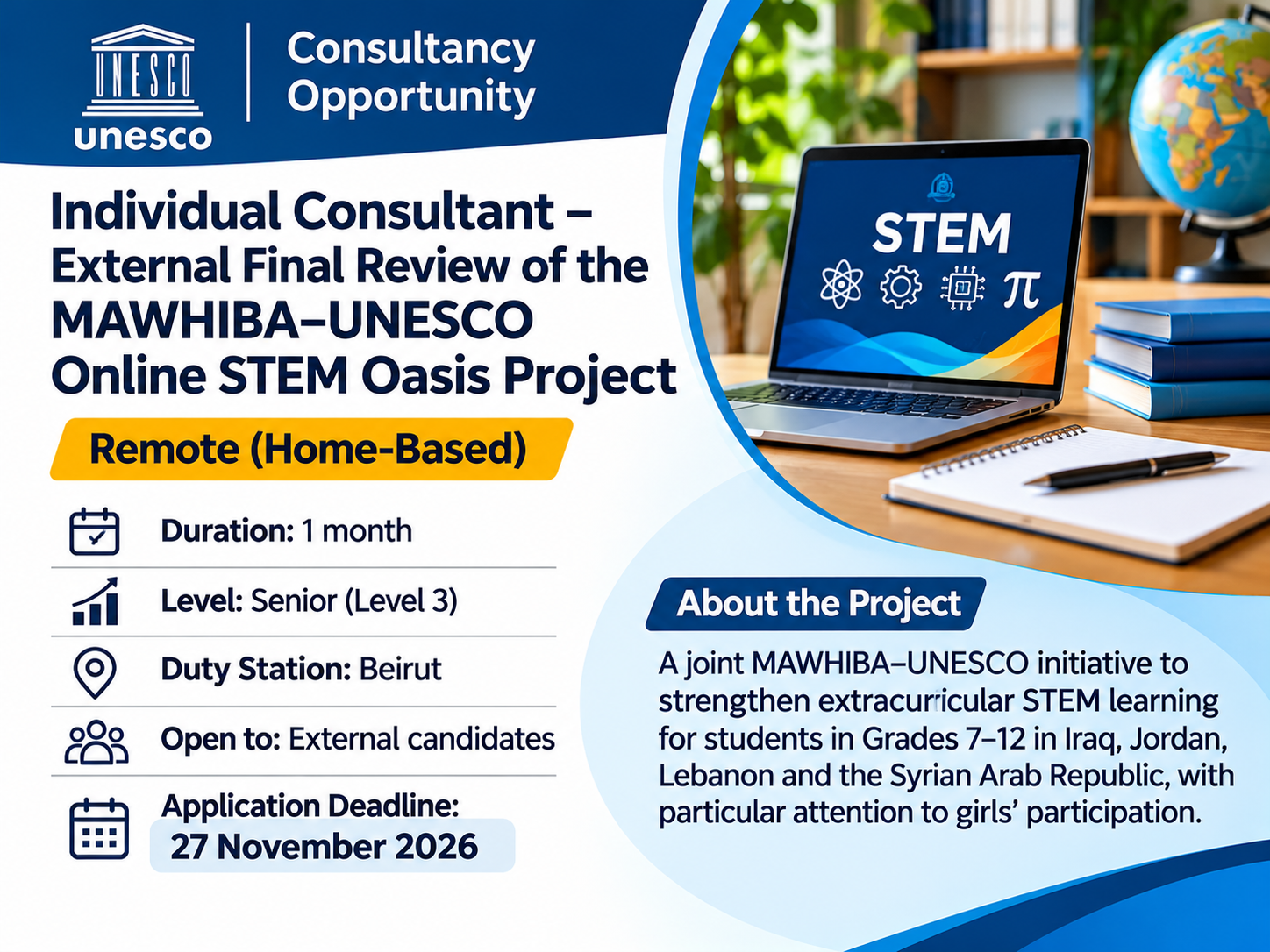
UNESCO is seeking applications for an Individual Consultant for the External Final Review of the MAWHIBA–UNESCO Online STEM Oasis Project. This is a senior-level consultancy opportunity that can be completed remotely, with the consultant working from home. The assignment is based administratively in Beirut, Lebanon, has a duration of one month, and is open to external candidates. The application deadline is 27 November 2026.
About the UNESCO STEM Oasis Project
The MAWHIBA–UNESCO Online STEM Oasis Project is a joint initiative between Mawhiba and UNESCO’s Regional Office in Beirut. The project has a total budget of US$250,000 and aims to strengthen extracurricular learning in science, technology, engineering and mathematics (STEM) for students in Grades 7 to 12 across the Arab region.
The first phase covers Iraq, Jordan, Lebanon and the Syrian Arab Republic, with particular attention to girls’ participation. The project combines digital learning resources with stakeholder engagement, including an online learning portal containing STEM videos and quizzes, outreach materials, stakeholder networks and national consultations.
According to the project status provided in the vacancy, all 350 planned STEM videos have been produced and uploaded, with accompanying quizzes. The online learning portal is operational and open for registration, while testing and the official launch are planned around the national consultations and late 2026 or early 2027.
Purpose of the Consultancy
UNESCO is commissioning an external consultant to conduct a final review of the project and assess its implementation, available results, lessons learned and prospects for sustainability.
The review will examine what the project delivered against its agreed objectives and planned outputs. It will also consider the relevance and usefulness of the digital learning resources and stakeholder engagement activities, implementation challenges, girls’ participation, accessibility and inclusion.
Importantly, the review is expected to distinguish between verified achievements, anticipated benefits and results that cannot yet be established based on available evidence.
Key Areas of Assessment
The consultant will apply the OECD-DAC criteria of relevance, coherence, effectiveness, efficiency and sustainability proportionately to the project’s scale.
The review will assess whether the project responded to the STEM learning needs of its intended beneficiaries, its alignment with national and partner initiatives, the extent to which planned outputs were delivered, resource use and implementation arrangements, and the prospects for continued use of the online portal and learning materials.
The geographical scope covers Iraq, Jordan, Lebanon and the Syrian Arab Republic. The assignment is home-based, with consultations conducted remotely unless otherwise agreed.
Methodology and Deliverables
The consultant will use a mixed-method approach combining qualitative and available quantitative evidence. Activities may include document review, analysis of platform usage data, review of selected STEM videos and quizzes, remote interviews and small-group discussions with relevant adult stakeholders.
The consultant is expected to review approximately 20–30 of the project’s 350 STEM videos using a purposive sample. No field missions are envisaged.
Key deliverables include a short inception report, preliminary findings presentation, draft review report and final review report. The final report will be limited to 20 pages excluding annexes and will include findings, conclusions, lessons learned and practical, prioritised recommendations.
The assignment requires approximately 22 working days over 8–9 calendar weeks, with the detailed schedule confirmed during inception.
UNESCO Consultant Requirements
Applicants must have an advanced university degree in education, STEM education, evaluation, social sciences or a related field.
At least seven years of relevant professional experience in project reviews, evaluations or applied programme research is required, including responsibility for at least two comparable reviews or evaluations.
Candidates must also demonstrate qualitative and quantitative methodological experience, technical experience in education, STEM or digital learning, and professional knowledge of education systems and implementation contexts in the Arab region. Experience in at least one of Iraq, Jordan, Lebanon or the Syrian Arab Republic is required.
Excellent English and Arabic communication skills are required, including the ability to conduct stakeholder consultations in Arabic and prepare reports and presentations in English.
How to Apply
Applicants must submit an updated CV, two recent review or evaluation reports, two professional references, a technical proposal, a separate financial proposal in USD, confirmation of availability and independence, conflict-of-interest disclosure and evidence of academic qualifications.
The application deadline is 27 November 2026 at midnight UTC+3. UNESCO states that it does not charge candidates any fee at any stage of the recruitment process.