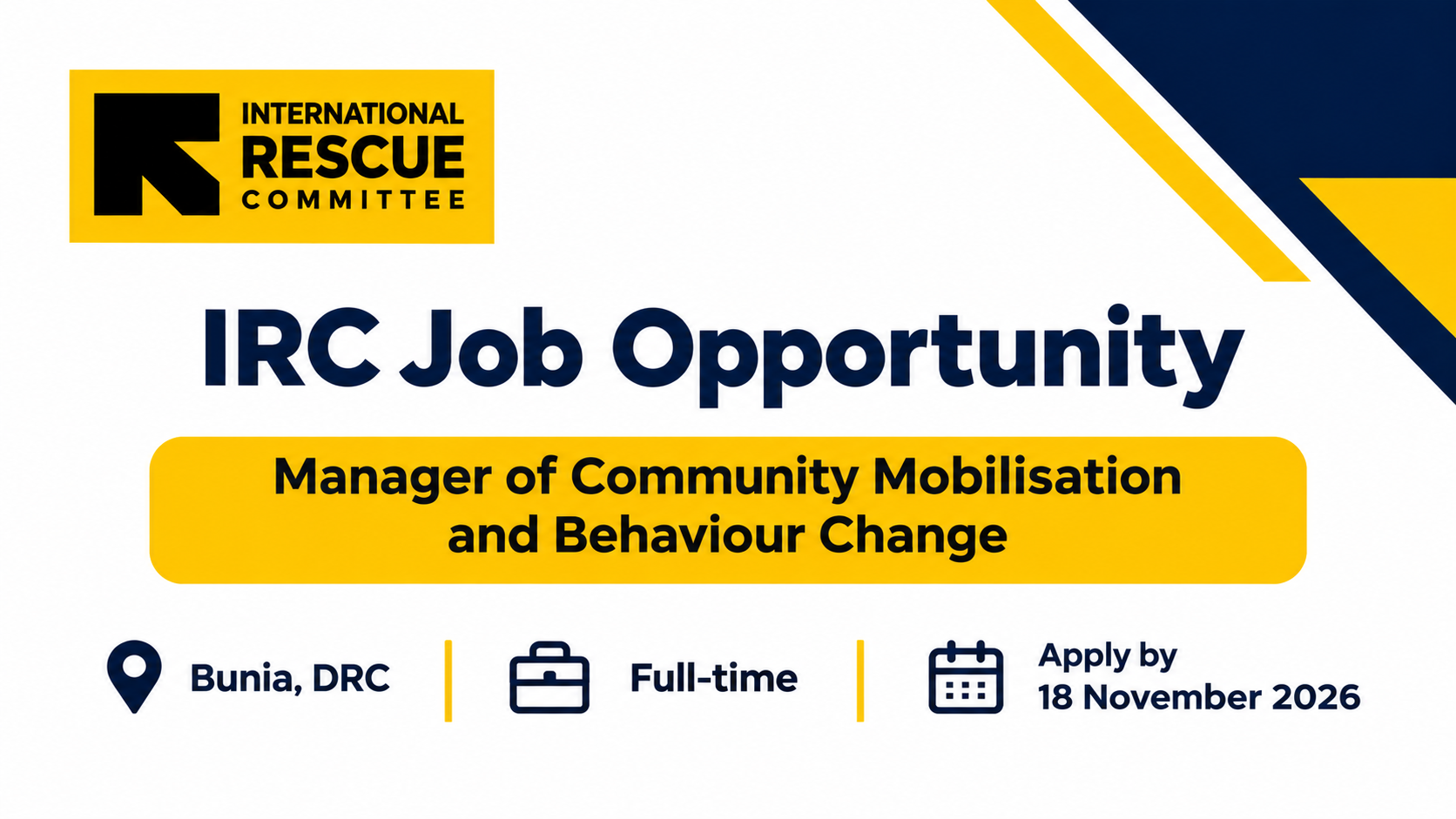

IRC Manager of Community Mobilisation and Behaviour Change Job 2026 in Bunia, DRC – Apply Before 18 November
The International Rescue Committee (IRC) is inviting applications for the position of Manager of Community Mobilisation and Behaviour Change (Manager en Mobilisation Communautaire et Changement de Comportements) in Bunia, Democratic Republic of the Congo (DRC). This is a full-time, in-person opportunity for an experienced humanitarian professional with expertise in community engagement, gender-based violence (GBV) prevention, child protection and emergency response.
The successful candidate will lead community mobilisation interventions aimed at improving the protection of populations affected by the Ebola Virus Disease (EVD), with particular attention to ensuring that survivors of gender-based violence can safely and equitably access essential support services.
Applications are open from 4 November 2026, with the recruitment deadline set for 18 November 2026. Interested candidates are encouraged to apply early because the organisation may close the recruitment process before the advertised deadline.
About the International Rescue Committee (IRC)
Founded in 1933, the International Rescue Committee is a global humanitarian organisation that responds to some of the world’s most serious humanitarian crises. The organisation works in more than 40 countries and 29 cities across the United States, helping people affected by conflict and disasters to survive, recover and rebuild their lives.
IRC has been operating in the Democratic Republic of the Congo since 1996. Its programmes address humanitarian and development needs among Congolese communities and refugees, with interventions covering healthcare, sexual and reproductive health, nutrition, water, sanitation and hygiene, child and women’s protection, governance, conflict management and economic recovery.
This recruitment is linked to a six-month assignment under the World Bank and the DRC Stabilisation and Recovery Project (STAR-RDC). The project focuses on preventing gender-based violence, strengthening institutional capacity, improving coordination and supervising comprehensive support services for survivors and vulnerable populations affected by the Ebola outbreak.
Job Overview
| Job Detail | Information |
|---|---|
| Organisation | International Rescue Committee (IRC) |
| Position | Manager of Community Mobilisation and Behaviour Change |
| Job Location | Bunia, DRC |
| Job Type | Full-time |
| Work Arrangement | In-person |
| Project | STAR-RDC |
| Application Opens | 4 November 2026 |
| Application Deadline | 18 November 2026 |
| Job Reference | JR00005804 |
| Duration | Six-month project assignment |
Key Responsibilities
The Manager of Community Mobilisation will work under the supervision of the Chief of Party and lead community-level interventions to improve access to protection and support services.
Key responsibilities include:
- Developing and implementing community mobilisation strategies in areas affected by Ebola.
- Integrating gender-based violence prevention, child protection, inclusion and community engagement into project activities.
- Analysing community dynamics, protection risks and barriers preventing survivors from accessing services.
- Establishing safe and confidential community referral mechanisms to connect survivors with medical and psychosocial support.
- Promoting awareness of available services and safe referral pathways.
- Working with communities to identify and address cultural, geographical and security barriers to accessing support.
- Facilitating community dialogue to improve acceptance of services for GBV survivors.
- Ensuring that all interventions respect confidentiality, dignity, informed consent and non-discrimination.
- Supervising community mobilisation activities and monitoring their quality.
- Strengthening the capacity of community leaders, local partners and women’s organisations.
- Collecting and analysing community feedback to improve project implementation.
- Promoting inclusive access to services for women, adolescent girls, children, persons with disabilities and other vulnerable groups.
The manager will also ensure that all activities follow the survivor-centred approach, the best interests of the child and the humanitarian principle of doing no harm.
Qualifications and Experience
IRC is seeking candidates with relevant academic qualifications and practical experience in humanitarian programming, community mobilisation and protection.
Applicants should meet the following requirements:
Education
A university degree (Bachelor’s or Master’s) in social sciences, sociology, community development, public health, psychology, social work or another relevant discipline.
Additional training in gender-based violence, child protection, community engagement or humanitarian project management will be an advantage.
Professional Experience
- At least three years of experience in community mobilisation, particularly in GBV, child protection or public health emergencies.
- Good knowledge of standards for GBV survivor support and referral mechanisms.
- Understanding of Risk Communication and Community Engagement (RCCE) approaches in Ebola response contexts.
- Knowledge of protection principles, confidentiality, Prevention of Sexual Exploitation and Abuse (PSEA), Accountability to Affected Populations (AAP) and safeguarding.
- Experience working in humanitarian emergencies, epidemic responses or programmes supporting vulnerable populations is strongly preferred.
Additional Skills
Candidates should demonstrate excellent analytical, written and verbal communication skills. They should also have the ability to organise training sessions, facilitate community awareness activities, strengthen local partner capacity and develop practical solutions to implementation challenges.
Applicants must be committed to IRC’s safeguarding, diversity, equality and inclusion policies.
How to Apply
Interested candidates must submit their applications in French. The application package must include:
- Application letter: A maximum of one page.
- Updated CV: No more than three pages, written in French.
- Professional references: At least four professional references, including one human resources reference. Each reference must include their name, position, telephone number, email address and a brief explanation of the professional relationship.
- Supporting documents: Copies of academic qualifications, certificates of service, recommendations from former employers, identification document, proof of residence and the mandatory job-seeker registration card issued by ONEM.
Applicants living with disabilities must clearly indicate this in bold at the top of their CV.
Application period: 4 November to 18 November 2026, midnight.
Candidates should submit their applications through the official IRC recruitment portal using job reference JR00005804.
Important Information for Applicants
IRC encourages candidates to apply as early as possible. Applications will be reviewed as they are received, and the recruitment process may close before the final deadline if suitable candidates are identified.
Only shortlisted applicants will be contacted.
IRC also highlights its commitment to supporting women in the workplace. Female employees are eligible for 14 weeks of fully paid maternity leave, alongside paid breastfeeding breaks of up to two hours per working day until the child’s first birthday.
IRC provides a competitive salary structure, annual leave and workplace flexibility measures designed to support employee wellbeing.
Recruitment safety notice: IRC does not request any payment or recruitment fees at any stage of its hiring process. Applicants should report any requests for payment using the organisation’s designated reporting numbers.
Why Consider This Opportunity?
This position offers an opportunity for an experienced humanitarian professional to contribute to community protection and emergency response in the Democratic Republic of the Congo. The role combines community engagement, institutional strengthening, GBV prevention and behaviour change in a challenging humanitarian environment.
Professionals with experience in community development, protection programming, public health emergencies and survivor-centred interventions may find this opportunity particularly relevant.
Application deadline: 18 November 2026.