
IMF Economist Program 2027: Three-Year Career Opportunity for PhD Economists at the International Monetary Fund
The International Monetary Fund (IMF) Economist Program (EP) 2027 offers recent PhD graduates in economics an opportunity to launch an international career working on some of the world’s most important economic and financial policy challenges.
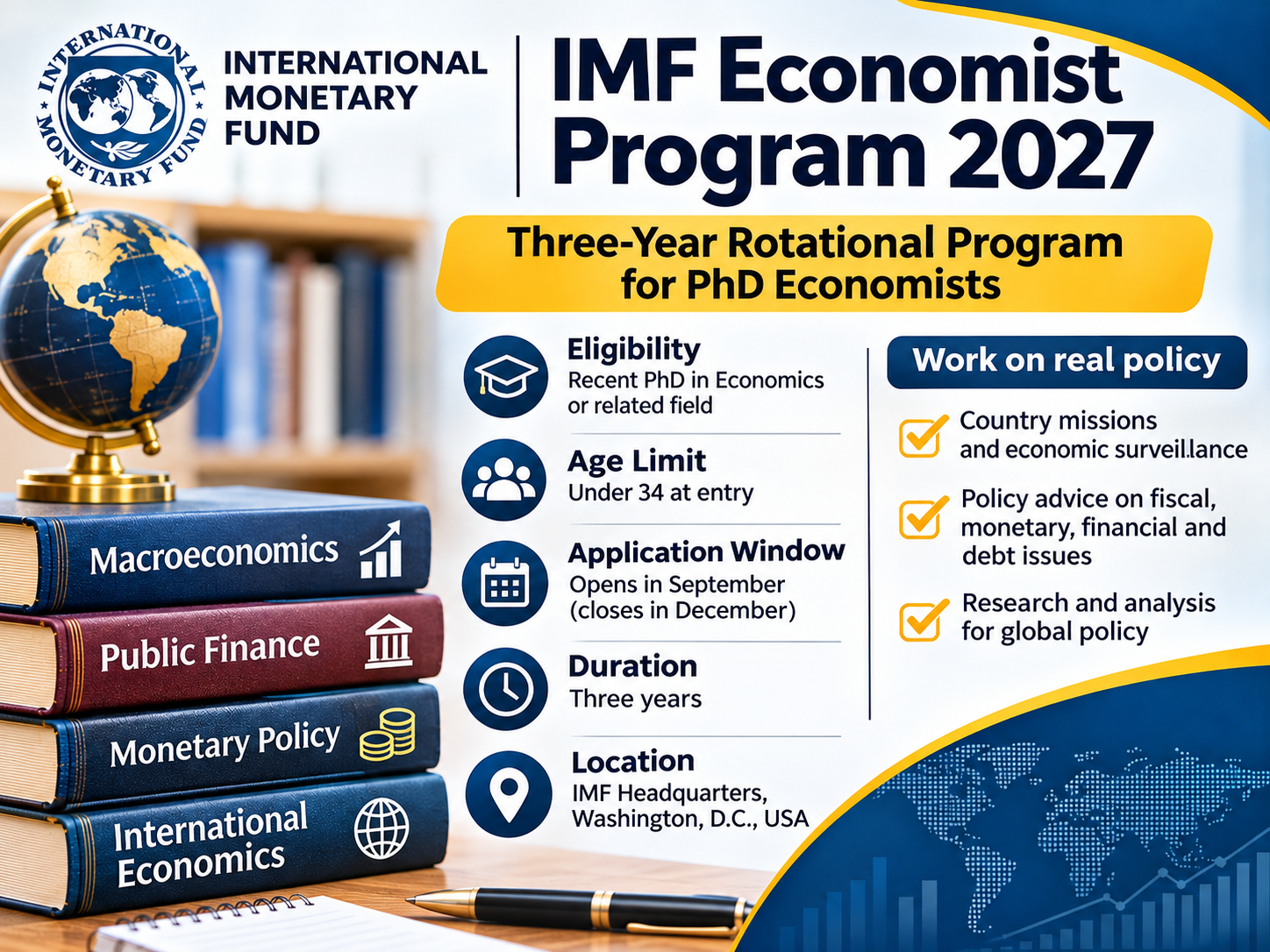
The three-year rotational programme is designed for talented economists who want to apply their academic research, quantitative skills and analytical expertise to real-world economic issues. Successful candidates gain hands-on experience across different IMF departments, participating in country missions, policy analysis, economic surveillance and research.
Participants work alongside experienced economists and contribute to policy discussions affecting the IMF’s 191 member countries.
The programme is particularly suited to recent doctoral graduates specialising in macroeconomics and related economic disciplines who are interested in international economic policy and global development.
1. About the IMF Economist Program
The IMF Economist Program is a three-year professional development and rotational programme that prepares outstanding economists for long-term careers at the International Monetary Fund.
The programme provides participants with broad exposure to the IMF’s operations and economic policy work. Rather than focusing exclusively on academic research, participants apply their knowledge to practical challenges facing economies around the world.
During the programme, economists rotate across different departments, gaining experience in country surveillance, policy development and economic research.
The programme provides a strong foundation for a long-term career as an IMF economist, allowing participants to develop specialised knowledge while gaining a broader understanding of the global economy.
2. What Does the Economist Program Offer?
Selected economists gain practical experience across several areas of the IMF’s work.
Country Work and Economic Surveillance
Participants contribute to IMF Article IV consultations and country programmes. This involves analysing economic developments, assessing policy challenges and advising member countries on economic performance and reform priorities.
Economic Policy Advice
Economists contribute to policy advice covering:
- Fiscal policy and public finances.
- Monetary policy.
- Financial sector stability.
- Public debt and debt sustainability.
- External sector developments.
- Macroeconomic management.
Research and Economic Analysis
Participants contribute to research and analytical work that informs IMF policy decisions and major institutional publications.
This provides an opportunity to translate academic research into practical policy recommendations with international relevance.
3. Eligibility Requirements
The IMF Economist Program is intended for exceptional early-career economists with strong academic and analytical backgrounds.
To qualify, applicants must meet the following requirements:
- Hold a recent PhD in Economics or a related field, or be within one year of completing their doctoral degree.
- Have a specialisation in macroeconomics or a related economic discipline.
- Be under 34 years of age at the time of entry into the programme.
- Demonstrate strong quantitative and analytical skills.
- Have excellent research capabilities.
- Be fluent in English.
Knowledge of additional IMF languages is considered an advantage.
Applicants should demonstrate the ability to apply economic theory, empirical research and quantitative methods to real-world economic and policy challenges.
4. Programme Duration and Career Opportunities
The Economist Program runs for three years and provides structured professional experience across different IMF departments.
Participants gain exposure to the institution’s core activities and develop expertise in international economic policy, country analysis and research.
After completing their rotations, economists continue building careers within the IMF, contributing to areas such as economic surveillance, research and policy development.
The programme is therefore not simply a short-term internship or research placement. It is designed as an entry pathway into a long-term career as an international economist.
5. IMF Economist Program Application Cycle
The programme follows an annual recruitment cycle.
The general recruitment timeline is as follows:
- September: Applications open. Preliminary interviews begin through on-campus and online recruitment.
- December: Applications close.
- December–January: Panel interviews and assessments take place at IMF headquarters.
- February: Successful candidates receive offers.
- September: The programme begins.
Applicants should consult the official IMF recruitment announcement for the applicable recruitment year and exact dates.
6. Selection Process
The IMF uses a competitive selection process to assess candidates’ academic abilities, analytical skills and suitability for the programme.
The selection process involves four main stages.
Step 1: Preliminary Interview
Candidates participate in an initial interview involving an overview of their research and a discussion of their academic and professional interests.
Step 2: Submission of Academic Documents
Shortlisted candidates are required to submit:
- Their research paper.
- Academic transcripts.
- Three academic references.
Step 3: Panel Interview and Written Assessment
Candidates participate in a panel interview and written assessment designed to evaluate their economic reasoning, analytical capabilities and ability to address practical policy challenges.
Step 4: Selection and Offer
Successful candidates receive offers to join the three-year Economist Program.
7. Why Apply for the IMF Economist Program?
The IMF Economist Program provides an exceptional opportunity for economists who want to work at the intersection of academic research, international development and economic policymaking.
Participants gain practical experience addressing complex economic issues affecting countries across the world.
The programme also provides opportunities to collaborate with internationally recognised economists, contribute to major policy discussions and develop expertise across different areas of macroeconomic management.
For recent PhD graduates interested in international economic policy, the programme offers a potential pathway towards a rewarding career in global economic governance.
The IMF Economist Program is an excellent opportunity for academically accomplished economists seeking to transform their research expertise into practical international policy experience. Eligible candidates are encouraged to monitor the IMF recruitment website and prepare for the annual application cycle.